Wednesday, August 13, 2008
Death and Dying
One of the doctors that I work with asked me to help her pronounce a patient dead. This involves doing a number of tests on the patient to be sure of death; listen to their heart and lungs (that aren’t beating), touch their eyes (that won’t blink), touch the back of their throat (that won’t cause a gag), and rubbing hard on their sternum (and they won’t try to stop you). This was all very academic while we did the tests, but after we stopped I had a second to myself with the cadaver to think. The very next week we had a lecture on Death and Dying. These two experiences got me thinking about death. Despite the fact that everyone is going to die, our culture is very far removed from death in our lives and most people haven’t ever seen someone die. Advances in medicine also help us live much longer and gives us a mini-delusion that medicine can cure just about anything. Sometimes, however, this prolongation of life is done so at great cost to the patient and with very little quality of life. We have a patient in the ICU that has advanced ALS (Amyotrophic Lateral Sclerosis AKA Lou Gehrig’s disease – You eventually lose all muscle control in an ascending pattern, but your sensation is still intact. Eventually people die because their diaphragm muscles gives out and they can’t breathe. It’s a terrible disease and a terrible way to die). He is now almost completely incapacitated. He has a ventilator breathing for him, he’s on a bunch of antibiotics because of infections, he has a very large bed-sore ulcer on one of his calves from having it lie on the bed without moving it, he is fed through a tube, he has an enema every other day to produce bowel movements, he has a catheter for peeing, and IV fluid because he can’t drink. The only thing that he can do is blink, and only sometimes at that. Should we continue to provide support for him despite the fact that he has 0% chance for recover or improvement? Should we discontinue treatment? This really isn’t my decision to make for him, but I do think is that people need to do is to come to grips with the fact that they will die and decisions need to be made concerning it. We can’t always control how we die, but there are some aspects of death and dying that can be dealt with and communicated to loved ones before they happen. In case anyone wondered, if I’m dying, I would like my family not to prolong my life by hooking me up to lots of machines but to let me die with dignity and peace

Friday, August 1, 2008
Culture of Complaining
I know complaining about one's job is by no means isolated to the healthcare arena, but I seem to have fallen into a pretty terrible cesspool of it. I heard long before starting my rotation (a 4 week stint) that the staff here "is sub-par as are many of the doctors". My collegues complain about the nursing staff not being prompt about doing their job, or about doing it poorly. They complain about doctors being annoying or not caring. They complain about the up-to-date electronic medical records and the awesome system they have set up for medical records. They even complain about the one free meal that is provided for us at the cafeteria. Seriously people, wake up and see the good things about where you work and what you do. To use a cliche analogy, they only see and complain about the thorns and can't even appreciate the roses. Part of these complaints have some validity, but nothing in our lives is ever going to be perfect, why do people have to go about being miserable because of it.
As I said earlier, this isn't isolated to my area of expertise, I have experienced this in every job school I've been at. When will people learn to see the good things that are around them and not get depressed and cynical about their situation. Or at least if they are could they at least learn not to bring me down with them?
As I said earlier, this isn't isolated to my area of expertise, I have experienced this in every job school I've been at. When will people learn to see the good things that are around them and not get depressed and cynical about their situation. Or at least if they are could they at least learn not to bring me down with them?
Friday, July 25, 2008
One of my common mistakes
Just in case anyone was wondering I learned again that baking soda and baking powder are not substitute-able. Oops.


Here are the differences between baking powder and baking soda.
Baking Soda - This can be the sole leavening agent if the dough has acids in it to react with (sourdough cultures, fermented milks - buttermilk/yogurt, brown sugar and molasses, chocolate, and cocoa - if not dutch processed, as well as fruit juices and vinegar).
Baking Powder - These are complete leavening systems: they contain both alkaline baking soda and an aid in the form of solid crystals.
This information was obtained from "On Food and Cooking: The Science and Lore of the Kitchen" by Harold McGee. It is a fantastic book if you are interested in cooking and want to learn more about how and why foods work.
Thursday, July 24, 2008
7-grain torpedo
One of the great dilemmas with bread baking is the cost benefit ratio.
Here are some of the "pros" for baking bread. It tastes amazing, seriously, nothing tastes quite like bread fresh from the oven. It makes the whole house smell great; who needs scented candles or potpourri anyway. It's usually cheaper than buying bread from the store. It's also satisfying to make a loaf.
Now for the "cons". It takes a lot of time to make a good loaf (see bottom for some of the tricks for making great bread), not much active time, but a decent amount of passive time. It doesn't last nearly as long as store-bought bread which means you would have to make it every other day or third day to have some on hand. And perhaps the greatest con (which is also a pro) is that when you have a fresh loaf of bread you want to eat the whole thing.
Overall we have concluded that if we were to make bread to save money it just doesn't add up. We could (and have) eaten a whole loaf of bread right out of the oven before, so it doesn't stay around for long. That doesn't mean that we don't make bread anymore, because it's hard to resist its siren song, but we just don't kid ourselves into thinking we're being economical by doing so. Here are some pictures of a 7-grain torpedo loaf that we made, whole grain and incredibly tasty. WooHoo.

P.S. There are a couple of ways of making yeast breads. In the Bread cookbooks we own or have perused they recommend using a dough "starter" to increase the flavor of the bread. A starter takes all the wet ingredients with half of the dry ingredients, whiskes them together and lets them sit at room temperature to ferment. This give the natural bacteria in all flours the opportunity to out-compete the yeasts for a little bit. Bacteria and their by-products are what give breads their distinct flavors while yeast provides lift and airyness. Many bread recipes in non-Bread Baking cookbooks advocate using much more yeast and leave out the starter to save on time. This starter takes a little more thought ahead of time, but the better taste is worth the effort.
Here are some of the "pros" for baking bread. It tastes amazing, seriously, nothing tastes quite like bread fresh from the oven. It makes the whole house smell great; who needs scented candles or potpourri anyway. It's usually cheaper than buying bread from the store. It's also satisfying to make a loaf.
Now for the "cons". It takes a lot of time to make a good loaf (see bottom for some of the tricks for making great bread), not much active time, but a decent amount of passive time. It doesn't last nearly as long as store-bought bread which means you would have to make it every other day or third day to have some on hand. And perhaps the greatest con (which is also a pro) is that when you have a fresh loaf of bread you want to eat the whole thing.
Overall we have concluded that if we were to make bread to save money it just doesn't add up. We could (and have) eaten a whole loaf of bread right out of the oven before, so it doesn't stay around for long. That doesn't mean that we don't make bread anymore, because it's hard to resist its siren song, but we just don't kid ourselves into thinking we're being economical by doing so. Here are some pictures of a 7-grain torpedo loaf that we made, whole grain and incredibly tasty. WooHoo.


P.S. There are a couple of ways of making yeast breads. In the Bread cookbooks we own or have perused they recommend using a dough "starter" to increase the flavor of the bread. A starter takes all the wet ingredients with half of the dry ingredients, whiskes them together and lets them sit at room temperature to ferment. This give the natural bacteria in all flours the opportunity to out-compete the yeasts for a little bit. Bacteria and their by-products are what give breads their distinct flavors while yeast provides lift and airyness. Many bread recipes in non-Bread Baking cookbooks advocate using much more yeast and leave out the starter to save on time. This starter takes a little more thought ahead of time, but the better taste is worth the effort.
Thursday, July 17, 2008
Why today?
The hospital that I work/study at services a lot of indigent people and those without insurance. Many of them are uneducated, unemployed, drink a lot, smoke a lot, don't have great hygiene and in general don't take great care of their health. That means that we see a lot of things that are downright disgusting. Take for example two people I saw today. One of them had scraped up their knee and now had a bacterial infection. That's not great, right? But it's just an infection you say, what could be that disgusting about that? And you would be right, except for the fact that the lady is only 5 feet tall and weighs over 350lbs. This person's calves were so big that my hands would have only gone half way around it. The best/worse part though, was that she was embarrassed about not being able to shave her legs!! Seriously woman, that's the least of your worries. She needs to lose 225 lbs and she's worried about not shaving her legs.
 Another guy that came in had something called "woody edema" or "crocodile skin" (see picture on right) and a necrotic lesion on his foot. Now when I say necrotic lesion many of you may not know what I mean. Essentially the blood backs up in the veins which causes the skin to not get enough oxygen and if this happens for a long time eventually the skin, fat, and muscle there will just die and decompose while still attached to someone's leg. This guy actually had maggots infecting his wound. Yup, that's revolting.
Both of these people made me ask the question, when is enough enough? Is this lady just waiting to pass 400 lbs before making serious changes in her life to lose weight? Was the guy just waiting for the necrotic lesion to get to his ankle before coming in to have it looked at? (incidentally he's going to have his foot amputated half-way up his foot). It just baffles the mind.
Moral of the story; Don't wait until it's disgusting, smells, and has maggots growing on it.
Friday, July 11, 2008
A little disapointing.
Melinda went to the store two days ago and found that a pint of raspberries were $0.99. Oh the possibilities. This is like finding $5.00 in a pocket you forgot about. We ended up making an almond raspberry tort.
https://www.gastronomyinc.com/recipes/rasp_almond.html
I'll briefly describe the tort (or torte) for you. It's composed of two egg-based cakes sandwiching a layer of raspberry-almond flavored pastry cream (a pudding mixture that most will know as the filling of eclairs).

https://www.gastronomyinc.com/recipes/rasp_almond.html
I'll briefly describe the tort (or torte) for you. It's composed of two egg-based cakes sandwiching a layer of raspberry-almond flavored pastry cream (a pudding mixture that most will know as the filling of eclairs).
If I had to review this one I would say that it had great potential, but for the lack of clear instructions the results won't turn out like they are supposed to (It really does taste amazing, though so I would still recommend it). Here are some suggestions we thought of from our first time making it.
1) The recipe tells us to make the pastry cream and then mix it with the egg whites that have been beaten to stiff peaks. There is no mention of timing here. I would recommend chilling the pastry cream for at least a couple of hours to really firm it up before beating the egg whites and folding them in.
2) Because the pastry cream wasn't thick enough, it just oozed out between the cake portions and was a mess. To remedy this perhaps cooking the bottom cake in a springform cake pan and/or simply assembling the cake inside one would be a good idea. This will help keep the pastry cream pudding from oozing out the sides while still allowing you to remove the sides and not have to dig the cake out and ruin it.
As a post-script, we refridgerated the tort and it firmed up nicely. It also tastes fantastic, but unfortunately that presentation was really crappy.
One of my greatest passions
I have a couple of great loves in my life. Food and cooking are two of these. Recently we have started growing an herb garden, and lame as that sounds, there is something uniquely satisfying about using your own herbs on something you cook. We have some Basil, Oregano, Thyme, Chives, Cilantro, and Mint that are all doing well (for some reason my Rosemary plant died and I had to take some cuttings to restart one). Last Sunday we marinated some chicken for kebabs in some olive oil, red wine vinegar, some salt and pepper, and 1/4 cup of freshly cut herbs. Normally this would have been a little expensive to go out and buy these herbs, but now I can go out and just pick some from my back steps. 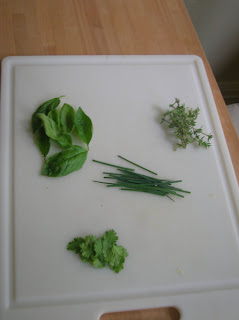 (Clockwise from upper left: Basil, Thyme, Chives, Cilantro)
In addition to the culinary benefits there is something incredibly fulfilling about growing plants. You go out there, you water them, tend them a little, and you get to watch the grow. It's hard to describe, but it's like creating your own oasis, your refuge from the storm of life. Okay, that was a little too "cliche poetry", but it really is close to how I feel. For anyone interested, growing a little herb garden or just a little plant is very rewarding.
 (Clockwise from upper left: Basil, Thyme, Chives, Cilantro)
In addition to the culinary benefits there is something incredibly fulfilling about growing plants. You go out there, you water them, tend them a little, and you get to watch the grow. It's hard to describe, but it's like creating your own oasis, your refuge from the storm of life. Okay, that was a little too "cliche poetry", but it really is close to how I feel. For anyone interested, growing a little herb garden or just a little plant is very rewarding.
Subscribe to:
Posts (Atom)